
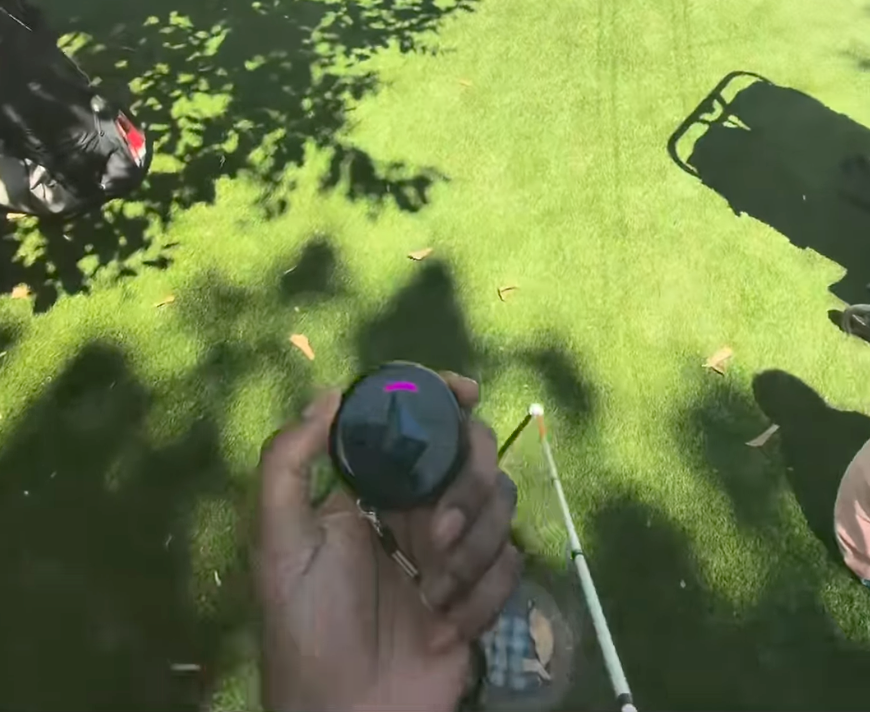
The Totem Compass is an offline wearable friend-finder designed to help people locate their friends and family without relying on phones or cell service.
Although Totem was originally created for music festivals, members of the Totem community now use their Compasses on hikes, ski trips, family vacations, at amusement parks, and in other crowded environments where groups can easily become separated.
One of the most meaningful use cases has come from blind and low-vision Totem users.
For people who can perceive light, color, or movement but have difficulty identifying faces or navigating visually complex spaces, the Totem Compass’ illuminated directional signals may provide another way to locate the people they are connected to.
Totem is not a replacement for a cane, guide dog, sighted guide, accessible navigation app, or other mobility aid. It serves a narrower purpose: helping someone determine the direction of a connected friend or family member when that person is difficult to see or identify.
Understanding Blindness, Low Vision, and Usable Vision
Blindness is a spectrum, and the amount and type of vision a person has can vary significantly.
In the United States, “legal blindness” generally refers to a visual acuity of 20/200 or less in the better-seeing eye with correction, a visual field of 20 degrees or less, or both. The American Foundation for the Blind notes that people who are legally blind often retain some usable vision.
Depending on the individual and their surroundings, that usable vision may include the ability to perceive:
-
Bright lights
-
Contrasting colors
-
Motion
-
Large shapes
-
Objects at close range
Someone may be able to see a bright illuminated signal in their hand while still being unable to recognize a person across a crowded room, distinguish faces in low light, or visually follow a group through an amusement park.
That distinction is central to understanding how the Totem Compass can help some blind and low-vision users.
How the Totem Compass’ Visual Navigation Signals Help Users Find Their Group
Each Totem Compass can be connected—or “Bonded”—to the Compasses carried by friends and family members.
When a user selects one of those connections, the Compass displays illuminated directional cues that point toward the other person’s Totem. These LED navigation signals are designed to communicate direction through bright, easily recognizable patterns rather than a map, screen, or text-based interface.
For some people with usable vision, those lights may be easier to identify than a person standing in a visually crowded environment.
Instead of searching for a specific face, outfit, or landmark, the user can follow the direction shown on the Compass toward the person carrying the connected device.
The core friend-finding experience also works without a phone or cellular connection. This can make Totem useful in places where phones are inconvenient, have lost service, have run out of battery, or have simply been left behind.
What the Totem Compass Can—and Cannot—Do
|
Common challenge |
How the Totem Compass may help |
What Totem does not replace |
|
Identifying a friend in a crowded space |
Displays an illuminated directional signal toward the friend’s connected Totem |
Facial-recognition or visual-assistance technology |
|
Staying with a group in an unfamiliar venue |
Gives the user a consistent direction to follow after becoming separated |
A cane, guide dog, sighted guide, or mobility training |
|
Losing access to a phone |
Core Compass-to-Compass locating does not require a phone |
Emergency communication or access to emergency services |
|
Navigating an area with limited cell service |
Uses Totem’s offline device-to-device network rather than a cellular connection |
Full turn-by-turn pedestrian navigation |
|
Managing multiple friends or family members |
Allows the user to switch between multiple connected Totems |
Supervision of children or vulnerable individuals |
Accessibility needs are personal, and the experience will not be identical for every blind or low-vision user. The best way to understand whether Totem is useful for someone is to let them experience the interface directly and provide their own feedback.
How Winston and Kate Knighton Helped Us Understand This Accessibility Use Case
Our understanding of this use case grew through conversations with Winston and Kate Knighton of the Future Shock Foundation.
The Future Shock Foundation works to create more inclusive spaces and experiences where blind and sighted people can connect. Winston has also used his platform to demonstrate how thoughtfully designed technology can support confidence, independence, and participation in public spaces.
Before meeting Winston and Kate, we assumed the Totem Compass would need haptic feedback or more advanced accessibility features before it could offer meaningful value to blind and low-vision users.
Their experience challenged that assumption.
For users who can perceive Totem’s illuminated Bond Lights and directional signals, the existing visual interface may already provide useful information—particularly when recognizing or locating another person would otherwise be difficult.
That discovery reinforced an important lesson for our team: accessibility cannot be evaluated through assumptions alone. It must be shaped by the lived experiences of the people using the product.
Finding Family at Disney World Without a Phone
One story Winston shared with our team demonstrated how simple offline friend-finding technology can become valuable in an unexpected moment.
During a family trip to Walt Disney World, Winston became separated from his phone. Despite not having access to it, he was able to use his Totem Compass to reconnect with his family near Space Mountain.
There was no need to call, send a text, share a location pin, or open a navigation app. His family members were carrying their connected Totems, allowing him to use the Compass’ directional signals to move toward them.
The story illustrates the specific problem Totem is designed to solve:
When you cannot see, call, or easily identify the people in your group, which direction should you go?
Totem does not attempt to describe everything in a person’s surroundings. Instead, it provides a simple answer to that single question.
Why Simple, Reliable Wearable Technology Matters for Accessibility
Blind and low-vision people increasingly have access to sophisticated tools that can read text, recognize objects, describe surroundings, and answer visual questions.
AI-powered smart glasses are one example. These tools can provide detailed environmental information that the Totem Compass is not designed to offer.
Totem fills a different role.
Rather than functioning as an all-purpose visual assistant, the Compass is designed around a focused task: maintaining a directional connection to the people who matter to you.
That simplicity offers several practical advantages:
No Screen or Menu Navigation
The Compass communicates through illuminated directional cues instead of requiring the user to read a map, interpret text, or navigate a complex interface.
No Phone Required for Core Friend-Finding
Once Totems are connected, the Compass-to-Compass experience can operate without a phone or cellular network.
A Focused, Always-Available Function
Because Totem is designed for friend-finding rather than continuous photography, audio, or AI processing, users do not need to manage a large collection of features when they simply want to locate their group.
A Wearable Form Factor
The device can be worn around the neck, keeping it accessible without requiring the user to hold or repeatedly retrieve a phone.
These features do not make Totem a complete accessibility solution. They make it a potentially useful addition to the broader collection of tools a person already uses.
Why Social Connection and Independent Participation Matter
Crowded social environments can create barriers for people who are blind or have low vision.
Finding friends at a festival, moving between family members at an amusement park, or reconnecting with a group at a public event may require additional planning and assistance. When those barriers accumulate, participating in social activities can become more difficult.
Research has also found an association between visual impairment and an increased risk of suicidal ideation, suicidal behavior, and suicide death. These outcomes are complex and cannot be attributed to vision loss alone, but the findings reinforce the importance of social inclusion, accessible environments, community support, and mental-health resources.
No consumer device can solve those broader challenges.
However, technology can remove individual points of friction. A tool that helps someone relocate their family, move more confidently through an event, or participate with less dependence on a phone may contribute to a more accessible experience.
That is the role we hope Totem can play.
Building More Accessible Technology by Listening to Blind and Low-Vision Users
The Totem Compass was not originally created as assistive technology.
Its usefulness to some blind and low-vision people emerged because members of that community tried the product, identified possibilities we had overlooked, and explained how it fit into their lives.
Their feedback has changed how we think about the product and its future.
As we continue working with Winston, Kate, and the Future Shock Foundation, our goal is to learn directly from blind and low-vision users, understand where Totem provides genuine value, and identify where the experience can be improved.
That process requires listening before designing—and recognizing that accessibility is not a feature a company can declare on behalf of its users.
It is something that must be developed with them.
Interested in Trying the Totem Compass?
Every person’s vision and accessibility needs are different. A visual interface that works well for one low-vision user may not be useful to another.
If you are blind, have low vision, support someone with vision loss, or work with an accessibility organization, we would value the opportunity to learn about your experience.
Contact the Totem team at tribe@totemlabs.com to tell us how you would use the Compass, what accessibility features would make it more useful, or how we can make future versions more inclusive.
The most meaningful product improvements rarely begin with an assumption. They begin by listening.
The Festive Owl's Totem Compass Review: First-Time User at Bonnaroo 2026
Totem Compass Version 5.0: Auto-Calibration, 12+ Hour Battery Life & Our Best Mesh Network Yet