
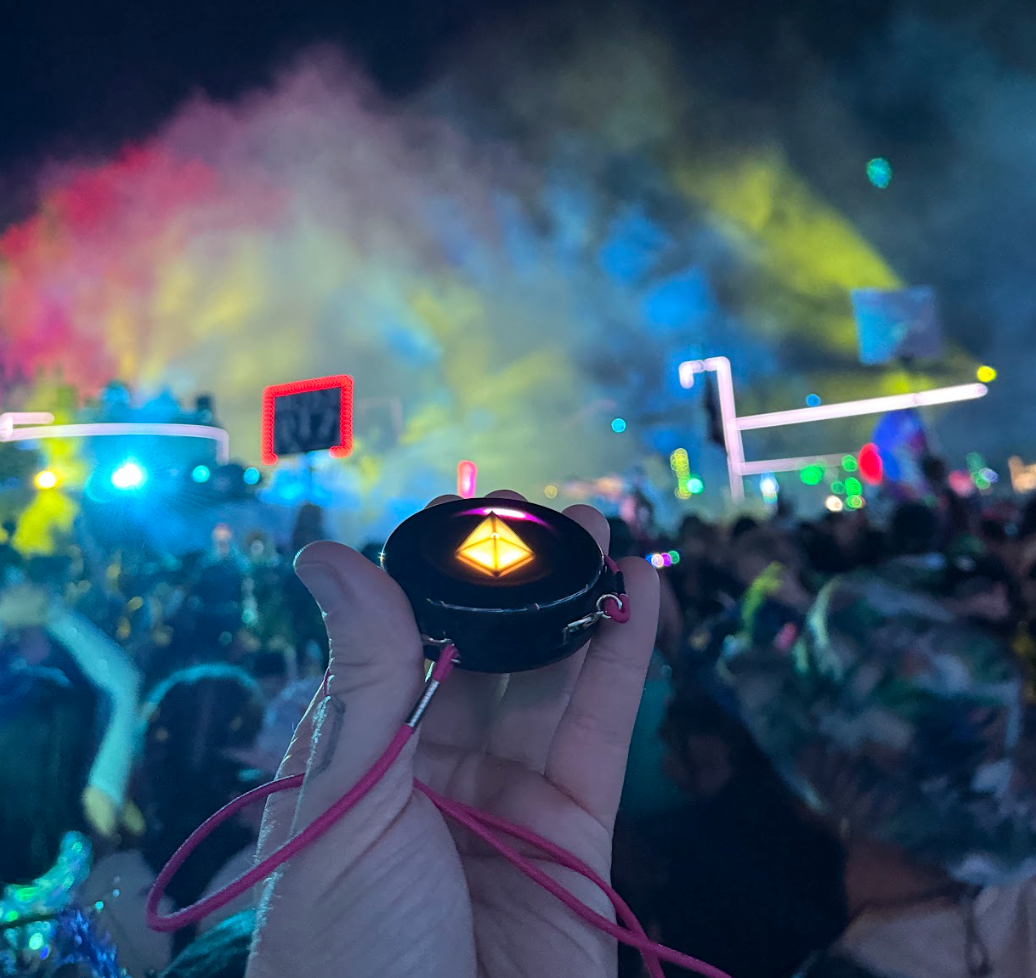
At Lost Lands 2026, a message on Totem’s Unity Mesh Network™ made 35 hops: it was passed from one Totem Compass to the next 35 times to reach its destination, with no cell towers, no Wi-Fi, and no phones involved. That’s an all-time record for the network, and it’s five times the maximum hop setting of Meshtastic, one of the best-known off-grid mesh platforms.
The Unity Mesh Network is the offline communication system built into every Totem Compass. Instead of sending your location through a cell tower, Totems pass small messages directly to each other. When a friend is too far away for a direct connection, other Totems in the crowd relay the message the rest of the way.
This page is our reference for how that network works and what it has actually done. It explains the 35-hop record (what we measured, what it means, and what it doesn’t), how multi-hop mesh networking works in plain English, and how the Unity Mesh Network compares with other mesh and tracking networks, from Meshtastic to Apple’s Find My.
The Record: 35 Hops at Lost Lands 2026
A hop is one jump from one device to the next. A message that goes from your friend’s Totem straight to yours has made one hop. A message that passes through three other Totems on the way has made four.
So a 35-hop message traveled from its sender, through 34 other Totem Compasses, to its recipient. Every one of those relaying Totems belonged to someone else at the festival, carried around a muddy valley by people who had no idea their Compass was helping.
How 35 Hops Compares
Most consumer mesh systems cap how many times a message can be relayed, because every extra hop adds traffic to a limited radio channel. Here’s how the published limits compare:
| System | What relays the message | Hops |
|---|---|---|
| Unity Mesh Network (Totem) | Dedicated radios inside each Totem Compass. No phone required | 35 recorded (Lost Lands 2026) |
| Meshtastic | LoRa radios running open-source firmware | Default 3, maximum 7 |
| goTenna Mesh | Dedicated radios paired with a smartphone app | Up to 6 (per goTenna’s Mesh community) |
| Bridgefy | Smartphones running the app, relaying over Bluetooth | Not published |
As of the date at the bottom of this page, 35 hops is more than any hop limit or record we’ve been able to find published for another consumer mesh system. If you know of a higher published figure, tell us at tribe@totemlabs.com and we’ll update this page.
How the Record Was Measured
- Event: Lost Lands 2026, Legend Valley, Ohio (September 2026)
- Software: Totem Compass Version 5.0
- How it’s counted: every message on the Unity Mesh Network logs how many times it has been relayed. The highest count in the festival’s network data was 35.
- Source: Totem’s Unity Mesh Network data from the festival, reported in Totem’s September 24, 2026 press release
- Conditions: an estimated 5,000+ Totem Compasses on-site among up to 50,000 attendees, through record rainfall and two evacuations
What 35 Hops Does and Doesn’t Mean
- It shows what the network can do in a dense crowd. Thousands of Totems in one place give messages many possible paths.
- It isn’t typical. Most messages need far fewer hops, and how many Totems are around you, and where, makes a big difference.
- It isn’t a range figure. Hops count relays, not distance. (The farthest distance the network recorded at Lost Lands was 1.58 km, with thousands of Totems relaying.)
- More hops isn’t automatically “better” for every system. Long-range radios like Meshtastic’s can cover a lot of ground in a few hops. Totem is built for a different job: thousands of moving people in one venue, with zero setup.
Why Cell Service Disappears at Festivals
A phone doesn’t talk to your friend’s phone directly. It talks to a cell tower, and the tower passes the message along. That works well until tens of thousands of people gather in one field and all try to use the same few towers at once.
Towers can only handle so many connections at once, and big outdoor venues are often far from the nearest one. Add a headliner, a crowd filming it, and a group chat full of “where r u,” and the network hits a wall. Texts stall. Your friend’s location in the app is from 40 minutes ago.
The Totem Compass was built for exactly that moment.
What Is an Offline Communication Network?
An offline communication network lets devices exchange information directly with each other, without cell towers, Wi-Fi routers, or an internet connection in the middle.
A walkie-talkie is the simplest example: two radios, talking straight to each other. A mesh network goes one step further. Every device in it can both send its own messages and pass along messages for other devices. Each device is called a node, and together the nodes form a web instead of a single line.

Traditional networks route everything through a tower. Offline networks let devices talk directly.
How the Unity Mesh Network Works
You don’t need to understand any of this to use a Totem. (That’s kind of the point.) But here’s what’s happening when you hold up your Compass and a light points at your friend.
Step 1: Two Totems Talk Directly
Each Totem Compass knows where it is using satellite positioning (GNSS). It then shares that location with the Totems it’s Bonded with. Bonds are the connections between two Totem Compasses, usually set up by holding two Totems together when you Bond your Totems.
Totems do this over their own peer-to-peer radio protocol on the 2.4 GHz band, with no phone, cell service, or Wi-Fi involved. On their own, two Totems can reach each other at up to roughly 1,000 meters (about 2/3 of a mile) in open, ideal conditions. In the real world, that distance changes with terrain, buildings, stage structures, and very large crowds of very wet humans, so it’s never guaranteed.
Step 2: Other Totems Carry the Message (Multi-Hop)
Here’s where the mesh comes in. If your friend is out of direct range, or a hill or a stage is in the way, other Totems between you can pick up the message and pass it along.
Each jump is a hop, and a chain of them is multi-hop communication: many short jumps that add up to one long connection.
The Totems doing the relaying don’t have to be Bonded with you, and they don’t need to do anything. They’re just being good citizens of the crowd. Relayed location data is encrypted, and a Totem that relays your message doesn’t display you. Only the friends you’ve Bonded with show up as lights on your Compass.

A message hops across other Totems to reach a friend on the far side of the festival.
Step 3: The Network Reroutes as the Crowd Moves
Festival crowds never sit still. A set ends, 20,000 people move at once, and the Totems that were bridging you and your friend are suddenly somewhere else.
The Unity Mesh Network is designed for that. Rather than relying on one fixed path, it keeps finding new routes through whichever Totems are nearby, routing around gaps and blocked paths as people move.
Why More Totems Make the Network Stronger
This is the part that runs backward from how cell networks behave. A cell network gets more congested as more people show up. A mesh network gets more paths. Every additional Totem on the grounds is another possible relay, which is why the Unity Mesh Network tends to work best at big, busy events.
It also works the other way around. The mesh only exists where Totems are. With just two Totems in an area, you’re working with their direct range. When the festival empties out, the mesh goes with it.

What Changed in Version 5.0
Totem Compass Version 5.0 (September 2026) included some of the biggest Unity Mesh Network improvements yet. It changed how Totems route information, prioritize messages, and handle more communication in each messaging window, with continued improvements to multi-hop performance in dense crowds.
Because it’s a free software update, every existing Totem Compass can get those improvements. If you’re heading to an event, update every Totem in your group first so everyone gets the best performance from the network.
More From Lost Lands 2026: The Network Under Real Pressure
Lab tests are nice. Festivals are the real exam. Lost Lands 2026 at Legend Valley, in September 2026, ran on Version 5.0, and conditions were rough: record crowds, roughly three times the normal rainfall for the time of year, and two evacuations, one on Saturday afternoon and one on Sunday night.
Here’s what Totem recorded over the three-day weekend:
| Attendance | Up to 50,000 individual attendees across three days |
| Totems on-site | An estimated 5,000+ Totem Compasses in use |
| Messages carried | 330,000+ messages peer-to-peer over three days, 12 times the total from Lost Lands 2025 |
| Longest relay chain | 35 hops, an all-time record for the Unity Mesh Network |
| Farthest distance | 1.58 km, the maximum distance recorded across the network at the event |
Source: Totem’s Lost Lands 2026 press release, September 24, 2026.
During both evacuations, crowds moved all at once and cell service was close to nonexistent. That’s precisely when a network that doesn’t depend on towers earns its keep, and Totem Compasses helped groups stay together and find each other again.
“Ours gets stronger because every Totem Compass on the ground makes the experience better for the people around it,” said Carter Fowler, Totem’s Founder and CEO.
What These Numbers Mean for You
They’re from one event, and Lost Lands had an unusually high number of Totems on-site. Your experience depends on how many Totems are around you, how spread out they are, and the terrain. Most of the time, you won’t see any of this. You’ll just see a light pointing at your friend.
How the Unity Mesh Network Compares to Other Mesh and Tracking Networks
“Mesh network” covers a lot of very different technology. Some meshes are built for hobbyist radio messaging, some for finding lost keys, some for smart meters. Here’s how Totem’s network fits in:
| Network | Built for | Needs internet to reach you? | Setup |
|---|---|---|---|
| Unity Mesh Network (Totem) | Finding friends in dense crowds, device to device | No | Turn on, Bond, go |
| Meshtastic | Open-source, off-grid text messaging over long-range LoRa radios | No | Choose a supported radio, install firmware, configure |
| Bridgefy | Offline text messaging between smartphones | No | Install the app; relays through nearby phones over Bluetooth |
| Apple Find My network | Locating lost Apple devices and items like AirTag | Yes. Nearby Apple devices report locations over their internet connection | Built into Apple devices |
| Amazon Sidewalk | Connecting low-power home and neighborhood devices (sensors, trackers, smart locks) | Yes. Sidewalk Bridges send data to the cloud over home internet | Built into compatible Echo and Ring devices |
| Industrial and utility mesh networks | Machine-to-machine telemetry, like meter readings and sensor data | Typically reports back to a central system | Deployed and managed by operators |
| Tactical and professional mesh radios | Team communication for trained crews, like military or first-responder units | Varies by system | Dedicated equipment, deployed and managed per team |
Open-Source Mesh: Meshtastic
Meshtastic is a genuinely great open-source project. It turns affordable LoRa radios into an off-grid messaging network, and LoRa links can cover several kilometers each. For hikers, preppers, and radio tinkerers, it’s an impressive tool, built and maintained by a volunteer community.
It’s also built around different trade-offs. Meshtastic limits how many times a message can be relayed: the hop limit defaults to 3 and can’t be set higher than 7. With long-range radios, a few hops can cover a lot of ground.
Totem’s design goal is different: thousands of people packed into one venue, moving constantly, with zero setup. The Unity Mesh Network relays through many short hops (35 at Lost Lands 2026), and the Totem Compass works out of the box without choosing hardware or configuring anything. Different tools, different jobs.
App-Based Mesh: Bridgefy
Bridgefy is a popular offline messaging app that relays texts between nearby smartphones over Bluetooth. It’s a clever way to message without the internet, and it has a very large user base.
The key difference is what does the relaying. Bridgefy runs on phones, so every link in the chain depends on another phone nearby, with the app installed, Bluetooth on, and battery to spare. Totems carry their own dedicated radios, reaching up to roughly 1,000 meters per hop in open, ideal conditions, and they relay for each other whether or not anyone’s phone is charged, in a pocket, or back at camp.
Big Tech Location Networks: Find My and Amazon Sidewalk
Apple’s Find My and Amazon Sidewalk are enormous networks, and they do use nearby devices to help relay information. But both ultimately depend on the internet to get that information to you.
In Apple’s own Find My security documentation, a nearby Apple device detects a lost item over Bluetooth and then uses its own network connection to report the location back to the owner. Amazon describes Sidewalk the same way: Sidewalk Bridges receive data from nearby devices, then use an internet connection to send it to the cloud.
That works well in a city full of connected phones. It depends on exactly what a packed festival with overloaded cell service can’t promise. The Unity Mesh Network passes friend locations Totem to Totem, so it doesn’t need a working connection to deliver them. (For a deeper look, see our Totem Compass vs. Apple AirTag comparison.)
To be fully transparent: the Totem Compass App does offer an optional cloud feature, for keeping track of friends who have left the event entirely. The mesh itself doesn’t need it.
Industrial and Tactical Mesh Networks
Some of the largest mesh networks in the world connect machines, not people: utility meters and factory sensors reporting numbers to a central system. Mesh radios also exist for military and first-responder teams, built for trained operators and usually deployed one team or mission at a time.
The Unity Mesh Network is built for the opposite situation: thousands of people who have never met, who didn’t read a manual, sharing one protocol at the same event. Every Totem on the grounds can help every other Totem, whether or not their owners know each other.
Why This Matters for Your Group
All the routing and hop counts come down to one practical outcome: less time searching, more time together. Split up for different sets, go refill water, wander off to the campground, and still find each other again without a single “WHERE ARE YOU” text.
It also means you’re part of something bigger than your own group. Totem now has more than 65,000 users in 80 countries, and every Totem Compass speaks the same Unity protocol. A Totem bought in London can relay for one bought in Tokyo the moment they’re in range of each other. Nobody at a festival has to be Bonded to help. Everyone’s Totem quietly helps everyone else.
And when something goes wrong, the same network carries SOS Mode. Press and hold the SOS button, and your light starts flashing on your Bonded friends’ Compasses so they know to come find you. SOS alerts your connected friends. It isn’t a replacement for event staff or emergency services.


Unity Mesh Network FAQ
Does the Totem Compass need cell service or Wi-Fi to find friends?
No. Totems share locations directly with each other and through the Unity Mesh Network, with no cell service, Wi-Fi, or internet connection required. You only need a connection for optional extras in the Totem Compass App.
What is a hop in a mesh network?
A hop is one jump from one device to the next. If a message travels from your friend’s Totem through two other Totems to reach yours, it has made three hops.
What’s the most hops a Totem message has made?
35 hops, recorded at Lost Lands 2026 on Version 5.0. That’s an all-time record for the Unity Mesh Network. Most messages need far fewer.
How far can two Totem Compasses communicate?
On their own, up to roughly 1,000 meters (about 2/3 of a mile) in open, ideal conditions. Terrain, obstacles, and crowd density all affect that, so range is never guaranteed. With other Totems around to relay, the Unity Mesh Network can extend that further.
Can strangers see my location if their Totem relays my messages?
No. Relayed location data is encrypted, and a Totem that relays your message doesn’t display you on its Compass. It simply passes the message along to the friend it’s meant for.
Does the mesh network work if my group are the only people with Totems?
Yes. Your group’s Totems relay for each other, too. Without other Totems around, though, you’re working with the direct range between devices, and the mesh gets stronger as more Totems join.
The More Totems, the Better It Gets
Cell networks buckle when the crowd shows up. The Unity Mesh Network was built for the crowd. Every Totem that walks through the gate is another relay, another path, another way back to your people.
That’s why it works best when your whole crew has one. The Totem Compass Bundle builder lets you customize the best Bundle for your group size, for up to eight people. The bigger the group, the lower the price per person. And nobody has to front the whole bill: at checkout, you can split the payment with friends using Paysquad.
Bond up, spread out, and go get lost in the music. The network will help you find each other again. 🫶
Build your group’s Totem Bundle →
Already have your Totems? Update to the latest software before your next event.
Last reviewed: September 2026. We update this page as new network records and data are verified.
Screen-Free Parenting: How to Keep Track of Kids at Large Events Without Handing Them a Phone
How the Totem Compass Performed at Okeechobee Fest 2026: Accuracy, Range, and What We Learned