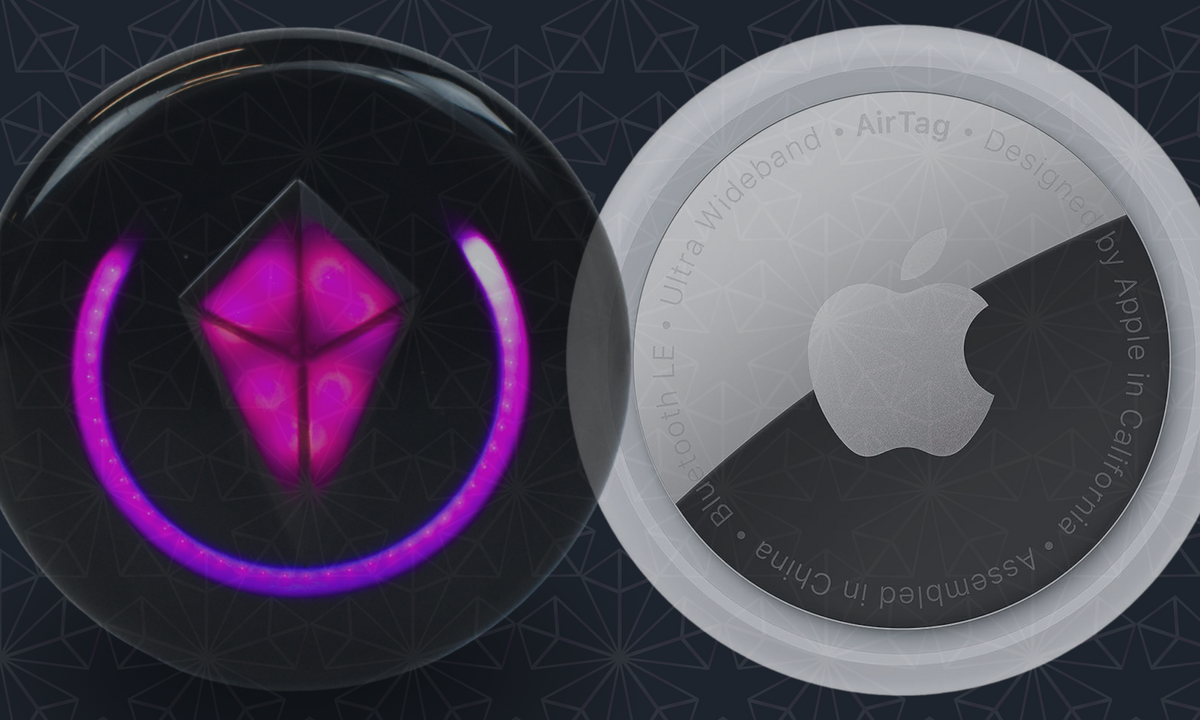
When you think of tracking devices, the Apple AirTag is probably the first thing that comes to mind. It’s a great way to keep tabs on your keys, your wallet, or that jacket you keep leaving behind. But how well does it work for finding people?
Short answer: AirTag is built for finding things. The Totem Compass is built for finding your people. Apple says so itself: AirTag was “designed to help people locate their personal belongings, not to track people.”
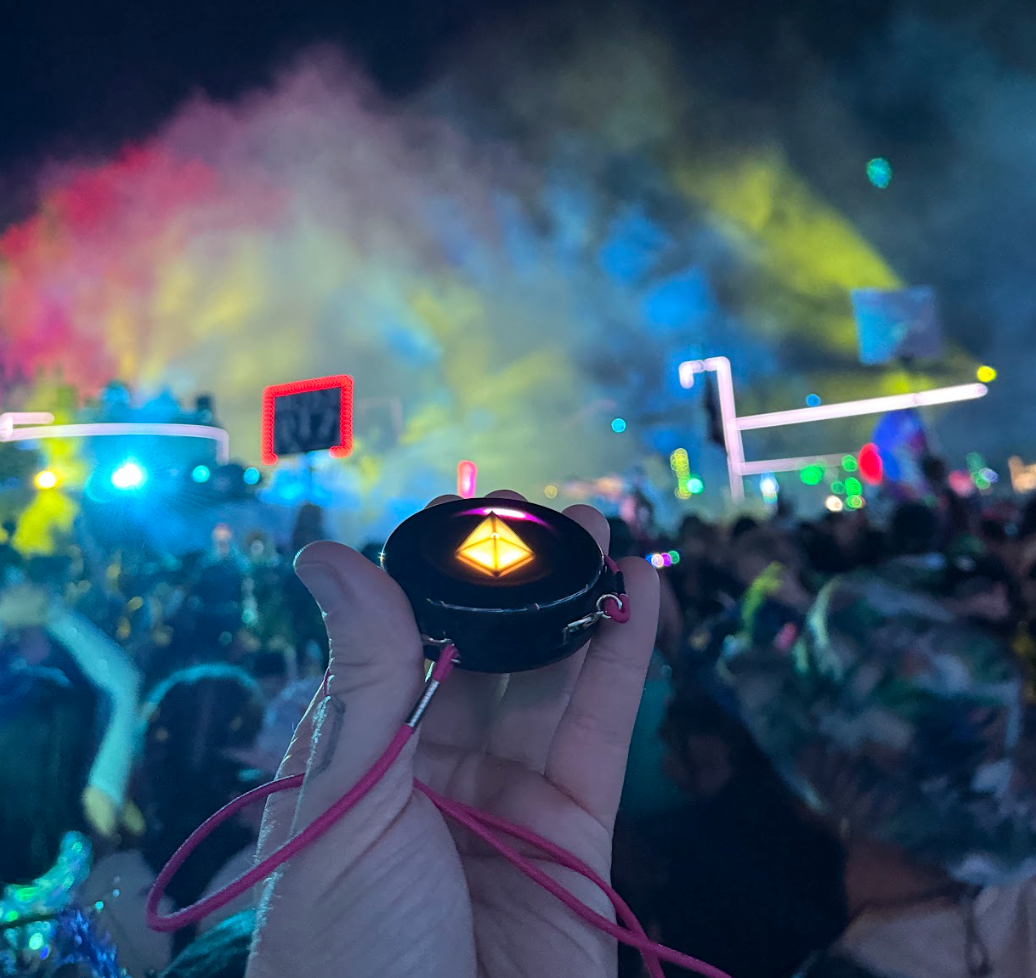
The Totem Compass is a screen-free wearable that points you toward your friends without relying on cell service. Your group Bonds their Totems together, and each Compass shows a light pointing toward every Bonded friend. That makes it a strong fit for festivals, theme parks, and other big, crowded places. AirTag is still the better tool for plenty of jobs, and we’ll cover those too.
Here’s a fair, side-by-side look at how the two compare, based on Apple’s own documentation and our published specs.
Totem Compass vs. AirTag at a Glance
| Totem Compass | Apple AirTag | |
|---|---|---|
| Designed for | Finding the people in your group | Finding personal belongings |
| How location reaches you | Directly from Totem to Totem, and through other Totems via the Unity Mesh Network™. No cell service or Wi-Fi needed | Nearby Apple devices detect it over Bluetooth and report its location over their own internet connection |
| Phone required? | No. The app is optional | Yes, an iPhone or iPad |
| Direction to your target | A light on your Compass points toward each Bonded friend | Precision Finding shows distance and direction when it’s nearby (compatible iPhones); otherwise, a location on a map |
| Range | Up to roughly 1,000 m (2/3 mile) between two Totems in open, ideal conditions; extended by other Totems nearby | Wherever Apple’s Find My network reaches, as long as connected Apple devices pass nearby |
| SOS | Yes. Alerts your Bonded friends, silently | No |
| Battery | Rechargeable: up to 12+ hours in Vibe Mode or beyond 20 hours in Eco Mode (Version 5.0) | More than a year on a replaceable coin-cell battery |
| Water resistance | Water resistant (not for swimming) | Rated IP67 |
| Consent | Both people Bond together, side by side | Alerts people when an unknown AirTag is traveling with them |
AirTag details from apple.com/airtag and Apple’s Find My security documentation, checked September 2026.
Do AirTags Need Cell Service? Not Directly, but They Need Someone’s Internet
An AirTag doesn’t have GPS or a cellular connection of its own. According to Apple’s security documentation, a nearby Apple device detects it over Bluetooth, then uses its own network connection to report an approximate location back to the owner.
In a city full of connected iPhones, that works really well. Apple says the Find My network can draw on more than a billion devices.
At a packed festival, it’s a different story. When the cell network is overloaded, the phones around your friend may not be able to report anything, and your own phone may not be able to load it. You end up looking at wherever the AirTag was last seen by a connected device.
The Totem Compass plays by a different set of rules. Each Totem works out its own position from satellites (GNSS), then shares it directly with the Totems it’s Bonded with, peer to peer. When other Totems are around, the Unity Mesh Network™ can relay locations from Totem to Totem, with no cell service, Wi-Fi, or phone involved.
To be fair about the limits: two Totems reach each other at up to roughly 1,000 meters in open, ideal conditions, and terrain, obstacles, and crowds shorten that. The mesh only exists where Totems are. (The optional Totem Compass App can also share locations over the internet when both friends are connected to it, but friend-finding itself doesn’t need it.)

Accuracy and Direction: Finding a Person in a Crowd
When an AirTag is close by, it’s very good at the last few steps. With a compatible iPhone, Precision Finding uses Ultra Wideband to show the distance and direction to it. Apple says the second-generation AirTag extends that range by up to 1.5x compared with the original.
Beyond Precision Finding range, though, you’re working with an approximate location reported by whatever Apple device last passed by. That’s fine for spotting your luggage at an airport. It’s harder when your friend is somewhere in a crowd of 10,000 people.
The Totem team LOVES using AirTags for finding our keys in the sofa cushions. But searching a packed crowd for a friend from an approximate dot on a map is bound to be a difficult experience. 😵💫
The Totem Compass works differently. Each Totem uses a multi-constellation GNSS receiver with satellite-based corrections, which in good conditions with open sky can pinpoint its position to within about 1 meter (3 feet). Near tall buildings, under trees, or during solar storms, that can drop to around 3–7 meters. Instead of a map, your Compass shows a light pointing toward each Bonded friend, from across the venue, not just when you’re close.
Real-Time Updates: Keeping Up With a Moving Friend
Friends at festivals are moving targets. 🏃
Apple doesn’t publish a fixed update interval for AirTag. An AirTag’s location updates when a connected Apple device happens to detect it and report in, so how fresh it is depends on who’s around and whether their phones have service.
Bonded Totem Compasses share their locations with each other directly, so updates arrive within seconds, not minutes. Whether your group is darting between stages or weaving through a packed amusement park, your Compass keeps pointing to where your friends are now.

Tracking a moving friend in real time with the Totem Compass.
SOS: Calling Your Friends When You Need Them
An AirTag has no way to ask for help. It’s a tag, and it does its job of being found.
The Totem Compass has SOS Mode. Press and hold the SOS Button, and your light starts flashing on your Bonded friends’ Compasses so they know to come find you, then follow your light to where you are. No fumbling with your phone, no texting your location.

Press and hold the SOS Button to alert your Bonded friends.
SOS is also silent. It doesn’t make a sound, so the people around you won’t know you’ve called in your backup. That matters if someone nearby is making you uncomfortable. 🫶
One important note: SOS alerts your connected friends. It isn’t a replacement for event staff, emergency services, or supervision.

Your friends can follow your light on their Totem Compass to find you.
Designed to Be Worn, by Everyone in Your Group
Let’s be honest: AirTags aren’t meant to be worn. They’re designed for things, which is why most people clip them to a keychain or drop them in a bag.
The Totem Compass, on the other hand, is wearable tech that actually looks good. It hangs on your chest like a piece of tech jewelry, and its Touch Crystal can be set to 13 different colors. Add a Skin and a necklace and it becomes part of your outfit, not something you hide.


That matters more than it sounds. Finding your friends is a lot easier when everyone in the group WANTS to wear the thing, as opposed to slipping an AirTag into a friend’s bag and hoping it stays there.
Set conflicts? Split up and meet back later. Waiting around for a friend at the bathroom line while missing an amazing performance? Go enjoy the set and find each other after. 🔥
The appeal goes beyond festivals, too. Some parents have told us their kids were the ones who wanted a Totem first, because of the design.
Screen Time: Glance at a Light, Not a Map
More and more people want to spend less time on their screens, especially at festivals and on family outings.
To locate an AirTag, you open the Find My app on your iPhone or iPad. That’s easy, but it means pulling out your phone every time you want to check.
Totems were designed specifically to minimize phone use. A quick glance at the lights and you know which way to go, so you can get back to the moment. That’s a big reason families like the idea, too. (For parents, we’ve written a guide to keeping track of kids at large events without handing them a phone.)

Whole squad Bonded and ready for the festival!
Privacy and Consent
A Bond is a two-way connection between two Totem Compasses, and it can only be made with both people’s Totems side by side. You can remove a Bond at any time, or simply turn your Totem off if you don’t want to be found.
AirTag handles this from the other direction: Apple designs it to discourage unwanted tracking, so if an unknown AirTag is traveling with someone, their iPhone or Android phone alerts them, and the AirTag eventually plays a sound. That’s a good thing, and it’s another sign that AirTag is built for belongings, not for keeping tabs on people.
When an AirTag Is the Better Choice
This wouldn’t be a fair comparison without it. An AirTag is the better tool when:
- You’re tracking belongings. Keys, luggage, bikes, backpacks. That’s exactly what it’s designed for.
- The thing is far away in a connected place. If your bag is across town or at the airport, the Find My network can report its location from almost anywhere connected Apple devices pass by. Totems are built for people within the same venue or area.
- You don’t want to charge anything. An AirTag runs for more than a year on a coin-cell battery. A Totem Compass needs recharging after a long day (luckily, it only takes about 45 minutes).
- It might get wet. AirTag is rated IP67. Totems are water resistant, but they’re not built for swimming.
- You’re on a tight budget and already have an iPhone. AirTag is $29 each or $99 for a four-pack on apple.com (September 2026), and it needs an iPhone or iPad to work.
And there’s nothing wrong with using both: AirTags on your bags, Totems on your people.
Totem Compass vs. AirTag: The Verdict
If you need to find your stuff, get an AirTag.
If you need to find your people, especially somewhere crowded where cell service is unreliable, the Totem Compass was built for that job. It points you toward your friends in real time without needing cell service, it lets anyone in your group call for their people with SOS, and it’s something everyone actually wants to wear.
Don’t just take our word for it. Check out our Totem Compass Reviews page and the Totem Compass Reviews YouTube playlist to see what real customers are saying, the good and the constructive.
Ready to outfit your group? The Totem Compass Bundle builder lets you customize the best Bundle for your group size, for up to eight people. The bigger the group, the lower the price per person. And nobody has to front the whole bill: at checkout, you can split the payment with friends using Paysquad.
Build your group’s Totem Bundle →

Totem Compass vs. AirTag FAQ
Can I use an AirTag to keep track of a person?
Apple says AirTag was designed to help people locate their personal belongings, not to track people. It also has anti-stalking alerts that notify people when an unknown AirTag is traveling with them.
Does the Totem Compass work without cell service?
Yes. Totems share locations directly with each other and through the Unity Mesh Network, with no cell service, Wi-Fi, or phone required. Two Totems reach each other at up to roughly 1,000 meters in open, ideal conditions, and range is never guaranteed.
Is the Totem Compass more accurate than an AirTag?
They work differently. Up close, AirTag’s Precision Finding is very precise. At a distance, AirTag relies on approximate locations reported by passing Apple devices. A Totem Compass uses its own satellite positioning, typically within about 1 meter in good conditions, and points you toward your friend from anywhere within range.
Does the Totem Compass need an iPhone?
No. Setting up, Bonding, and finding your friends all work without a phone. The Totem Compass App is optional.
Last reviewed: September 2026. AirTag details reflect Apple’s published information at that time.