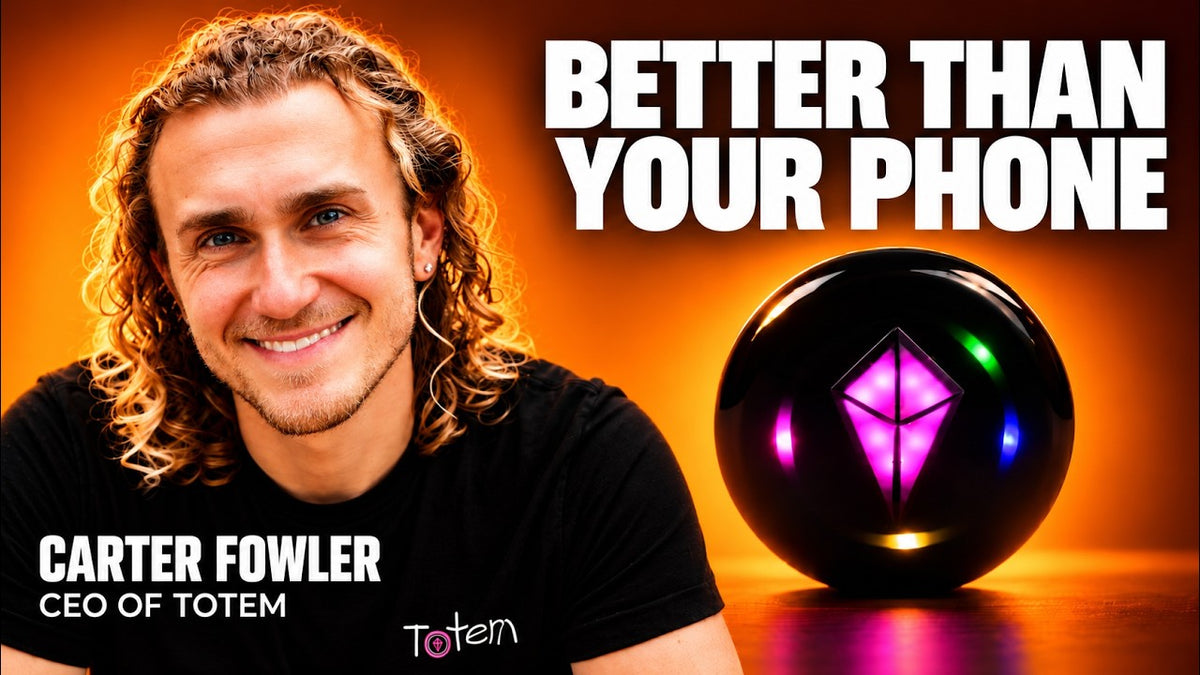
On October 12, 2026, Totem co-founder and CEO Carter Fowler joined co-host Alex Wilhelm on This Week in Startups (TWiST), one of the longest-running podcasts in the startup world. Episode 2349 is titled, fittingly, “The Gadget That’s Better in Crowds Than Your Phone.”
Over about 37 minutes, Carter and Alex covered why your phone fails at exactly the moment you need it most, how the Unity Mesh Network™ gets stronger as crowds grow, why Apple probably won’t build this into an iPhone, and where Totem is headed next.
Below you’ll find the full episode, the biggest moments with direct quotes, and a complete transcript of the Totem interview.
The Totem interview runs from the start of the episode to about the 38-minute mark. Prefer audio? Listen on Apple Podcasts or TWiST’s Substack.
New to Totem? The Totem Compass is a screen-free wearable, about 2 inches (50 mm) across, that helps you find your friends without relying on cell service. You Bond your Compass with your friends’ Compasses (a Bond is the connection between two Totems), then hold it flat and follow the light to your person.

Why a TWiST Feature Is a Big Deal for Totem
This Week in Startups has been documenting startups since 2009 and is now past 2,300 episodes. It was created by Jason Calacanis, an early investor in companies like Uber, Robinhood, and Calm, and today it’s co-hosted by Alex Wilhelm, a longtime tech journalist who covered startups and venture capital at TechCrunch. If you want to know how founders and investors think, it’s one of the shows people actually listen to.
A few reasons this one matters to us:
- It’s a full-circle moment. Carter opened the interview by explaining that Totem’s very first angel investor is the person who introduced him to TWiST. He started listening about two years before Totem existed, and the show helped him understand how investors think.
- TWiST doesn’t usually talk about hardware like ours. In Alex’s words: “We haven’t talked as much about hardware, and we certainly haven’t talked about consumer hardware that doesn’t depend on AI.” His intro didn’t hold back, either: “I love this company. I love this founder. I love that it’s working on bringing people together out in the world.”
- We shared an episode with Ring. The second half of E2349 is a flashback to Jason’s 2017 CES interview with Ring founder Jamie Siminoff, about a year before Amazon bought the company. A doorbell that started in a garage and created a whole new category of device, sharing an episode with a compass that finds your friends without cell service. We’ll let you draw your own conclusions. 😏
Most importantly, it put a simple idea in front of a huge audience of founders and investors: the world keeps getting more crowded, and the networks we rely on keep failing in exactly those crowds.

totemlabs.com, as shown at the end of the interview. (Screenshot: This Week in Startups E2349)
The Biggest Moments From Carter’s TWiST Interview
Timestamps refer to the YouTube version of the episode.
“Every major gathering is basically a failure condition” (4:27)
Alex asked Carter to describe the problem, and he went straight to the experience every festivalgoer knows:
“You have full bars on your phone, and somehow a single text can’t go through. You can’t load a single webpage. You look to your right where they were just a minute ago, and instead it’s just a mass of strangers, and you have no way to get in touch with them.”
His explanation for why: “In today’s world, with today’s population density, every major gathering is basically a failure condition for conventional connectivity networks.”
Totem works the opposite of a cell phone (6:42)
“The more cell phones you get in an area, the worse they all work. The more Totems you get in an area, the better they all work.”
Every Totem Compass acts as a relay in the Unity Mesh Network™, passing messages along for the people around it, even strangers. Carter used Lost Lands 2026 as the example: an estimated 5,000+ Compasses on-site, roughly 10% of attendees. That weekend, the network set all-time records: 35 hops, more than 330,000 messages carried, and a maximum distance of 1.58 km, with no towers or infrastructure needed.
He was also candid about the hard part: every mesh network has a “cold-start problem.” It gets more valuable as more people join, so the challenge is reaching enough adoption to make it great for everyone. That’s why Totem priced its first Compasses so low, sometimes at cost, to seed the network.

“Follow the pretty lights,” as shown on TWiST. (Screenshot: This Week in Startups E2349)
Why Totem beats your phone’s GPS in a crowd (9:07)
The Totem Compass combines three technologies: satellite positioning (GNSS, pulling from multiple satellite constellations, not just America’s GPS), a direct Totem-to-Totem radio link on 2.4 GHz, and the Unity Mesh Network™. Carter said one-meter accuracy has been Totem’s median over the past year, the kind of number Reddit commenters have called “technologically impossible.”
Phones, he explained, are designed around the assumption that you’ll always have a data connection, blending GPS with cell-tower triangulation and nearby devices. In a dense crowd, that can mean drift of dozens of feet or more:
“150 feet can sometimes mean 100, 200, 300 people between you and finding your child in the middle of a field.”

Three technologies, zero bars: satellite positioning, a direct Totem-to-Totem link, and the Unity Mesh Network™. (Screenshot: This Week in Startups E2349)
Why Apple won’t build this into the iPhone (13:34)
It’s the question we get constantly, and Carter’s answer was about business models, not technology:
“Large companies like Apple, Samsung, any of these, rarely ship products or technology that undercut their core business model.”
Phones are built to keep you connected to a central network, he said, and shipping a fully offline, decentralized mesh would put phone makers at odds with some of their biggest commercial partners. Alex’s response: “There’s a book written about this,” pointing to Clayton Christensen’s The Innovator’s Dilemma.
“You buy it once, you own it for life”
When Alex asked whether a Totem is something you buy and simply own, Carter’s answer is one we’d put on a T-shirt:
“The Totem represents your relationships. This is a connection to your people that we can never revoke. You buy it once, you own it for life. We never plan to revoke access to the network based on any kind of subscription fees.”
He did note that optional premium features are planned down the road. The core Compass and its network, though, stay yours.
Groups keep getting bigger, and friends sell Totems to friends
Carter shared that the typical Totem order has grown from about 2.6 Compasses in the early days to around 3.8 or 3.9 today, which makes the four-pack the most popular choice. And around 30% of recent customers told us at checkout that they came to Totem because someone recommended it, or because they saw someone wearing one at an event. (Alex’s take: a glowing Compass on your chest is “brilliantly also a native advertisement for itself.”)

The Bundle builder on screen: bigger groups get bigger discounts. (Screenshot: This Week in Startups E2349)
Hardware in an AI world (18:10)
Carter described fundraising as a startup that isn’t building AI: years of investors who only wanted B2B SaaS, then a year where AI had to be in every pitch deck. In 2026, he said, that’s shifting:
“Hardware, and in particular hardware that generates proprietary data, is what some people see as really the only remaining moat in a world where pretty much any SaaS product could be rebuilt overnight.”
Alex also pointed out how much of Totem’s funding has come from its own community. Alongside a $1.3 million pre-seed round from angel investors, Totem’s WeFunder Community Round closed at $1.36 million. Raising from the people who use your product, Alex said, is “like the definition of product-market fit.”

Small size, serious hardware: the inside of a Totem Compass, as shown on TWiST. (Screenshot: This Week in Startups E2349)
Predicting crowds before the gates open (23:08)
Alex asked about the data side. Carter was clear that the data Totem collects is aggregated and anonymous, and that what the team monitors is how the network itself behaves. The long-term vision is a predictive model of crowd movement, so organizers can “watch their weekend unfold before the gates open” and test changes like adding an exit or moving a stage before a single ticket-holder arrives.
Kids, ski patrols, and accessibility (28:04)
Totem was designed to be “simple enough and durable enough for a five-year-old to use,” and Carter said families with kids, especially kids under 12, are probably Totem’s second-largest group of customers after live-event fans. He shared stories from a dad in Australia who said nothing he’d tried performed better for his kids, a mom in the UK who finally felt OK letting her child walk to school, and ski patrol leaders in Colorado using Totems to coordinate their teams.
The one that got the biggest reaction from Alex: Carter said Totem has become popular in the blind and deaf communities as an accessibility tool. Many people with low vision can’t make out a face more than a few feet away, but they can hold up a Compass and follow a bright light. (Parents, our guide to keeping track of kids at large events without a phone goes deeper.)
The last frontier is congestion (35:47)
Alex closed by asking whether mesh devices could help in places like Ukraine, where communications are jammed. Carter’s answer zoomed out to the big picture:
“The real last frontier, the big unsolved problem with connectivity, is not coverage anymore. It is congestion.”
What’s Next for Totem, According to Carter
Carter also previewed several things Totem is working on. None of these are available yet, and plans and timing can change, but here’s what he described:
- Offline messaging and offline social networking over the Unity Mesh Network™, so you can not just find your friends but talk to them, and meet people at the event who share your interests
- On-site rentals at venues, with a first pilot planned around New Year’s Eve
- A wristband attachment, for people who’d rather not wear a Compass around their neck
- A smaller device for kids (working title: the Buddy Band)
- Satellite-free positioning inside the mesh, plus solar charging, with the long-term goal of full independence from infrastructure
- A predictive crowd-flow model for event organizers, which Carter said is ready to pilot in the next three to four months
We’ll share details on each of these here on the blog as they get closer.
Watch or Listen to the Full Episode
Want to go deeper on the tech Carter described? Start with how the Totem Compass works and how the Unity Mesh Network™ works.
Full Transcript: Carter Fowler on This Week in Startups (E2349)
Read the full transcript of the Totem interview (about 37 minutes)
This transcript covers the Totem interview, the first segment of This Week in Startups E2349, published October 12, 2026. It was produced from the episode’s automated transcript and lightly edited for readability: filler words are trimmed, sponsor reads are removed and marked […], and words we couldn’t make out are marked [inaudible]. Words in [brackets] were added by us for clarity. Speakers: Alex Wilhelm, co-host of This Week in Startups, and Carter Fowler, co-founder and CEO of Totem.
Alex Wilhelm: Hello and welcome back to TWiST. My name is Alex. I’m a regular co-host here on the show. Today we are talking to a founder of a company that is building not an AI model, not AI infra, not AI connectivity, not even something for the enterprise. They have built a consumer device that helps you stay connected to your friends when you’re out in the world, especially when your cell phone is going to struggle the most. I love this company. I love this founder. I love that it’s working on bringing people together out in the world. So please join me in welcoming [Carter Fowler of] Totem Labs to the show. […]
Alex Wilhelm: All right, Carter, how you doing?
Carter Fowler: Great. Thanks for having me on, Alex. To be honest, it’s a little surreal to be here. We didn’t found Totem that long ago, and our very first angel investor at the company, actually our only investor that I knew before the company, was the one who originally turned me on to TWiST. I started listening to it about two years before we founded the company, and this podcast was a big aid in helping me understand how investors think in the first place. So this is a pretty cool full-circle moment.
Alex Wilhelm: I’m so glad to hear that. And I’m so stoked to talk about what you’re building, because here on TWiST, as you can imagine, we’ve been talking a lot about AI for years now. We haven’t talked as much about hardware, and we certainly haven’t talked about consumer hardware that doesn’t depend on AI. So I’m really glad you’re here. To catch everyone up, we’re talking about Totem, or Totem Labs if you want, and you guys have put together a gadget that [helps] groups [inaudible].
Carter Fowler: Correct. Yeah. Well said.
Alex Wilhelm: So you’re wearing this gadget. For folks out there who are listening on the audio version, describe what it looks like, and also how much does it weigh? And then also describe how you’re wearing it, if you don’t mind.
Carter Fowler: Yeah, so our flagship consumer product here is called the Totem Compass. It’s traditionally worn as an amulet, pendant style. You can see it on my chest right here. It has a nine-axis IMU in it, so the second you pick it up, it automatically, or as I like to say, “automagically,” goes into Compass Mode and starts pointing you in the direction of your family, friends, whoever you need to find at the event. It’s an offline communicator, so it can also communicate SOS status if you’re in some state of distress. We have offline texting coming out through our mobile app as well, soon. And it’s incredibly light, probably lighter than you think, and it works just like a traditional compass. You can think about it like Captain Jack Sparrow’s magic compass from Pirates of the Caribbean, right? It points you to what you want most in the world, as long as you know what you want. We haven’t quite gotten to the point where we can point you to anything you want in the world, but we do have your back if you’re looking for the people that you love.
Alex Wilhelm: The way that I understand it is that if you have a couple of different friends and you hold up the Compass, it’ll display lights on different corners pointing you towards different friends. So I might know that blue is Carter, and then I can follow the blue angle towards you. Does it tell me how far away you are?
Carter Fowler: Yeah, it tells you the exact bearing and also relative distance. We designed it to be super simple and intuitive. We stripped so many features away from it in the early days to make it as simple for people to grasp as possible. That’s also a big reason why we went with the compass form factor in the first place. People know it. As you get further from people, [their light] is smaller. As you get closer to them, it gets larger and larger. Then when you find your person, you collect them into your Crystal at the very end. So when you have your whole family or all your friends with you, all of their lights are just within your little Crystal.
Alex Wilhelm: So when you’re in the car on the way home from the festival, all of your Compasses are going to be aglow like a Christmas tree. Okay. We need to describe the environment you are solving for, because I think a lot of people are saying, “Well, how often would I need this? What’s the actual use case?” So why don’t you tell me about festivals like, for example, Lost Lands, where people love to come together. It’s often dark and bright at the same time, and you might get a little bit further away from your friends than you meant to.
Carter Fowler: Yeah, well, festivals can be pretty chaotic environments. They’re a great time, obviously, but it’s the case for pretty much any large-scale event, right? We made this because the world is an increasingly crowded place every single year. And if there’s one thing that human beings love to do, pretty much since the dawn of time, it’s gather, right? We love to gather. But in today’s world, with today’s population density, every major gathering is basically a failure condition for conventional connectivity networks.
So we built an autonomous mesh network called the Unity Mesh Network that allows you to stay connected with all of your people, no matter what, and overcome those types of environments. Because the reality is, at a major festival, whether it’s Lost Lands or Electric Daisy Carnival, or even CES, if you were at CES earlier this year, there are so many people in the area. You know this experience. You’re there with your friends and family, you have full bars on your phone, and somehow a single text can’t go through. You can’t load a single webpage. You look to your right where they were just a minute ago, and instead it’s just a mass of strangers, and you have no way to get in touch with them. These environments, especially something like EDC Las Vegas, are some of the most challenging environments in the world for communication technology, other than maybe active war zones or—
Alex Wilhelm: Disaster areas. The front lines of Ukraine and EDC.
Carter Fowler: Yeah, something like that. And so that’s why it’s so important that this mesh network works completely offline. It’s an autonomous, self-governing network. It automatically manages usage across the mesh to maximize utilization while also preserving battery life and bandwidth for everybody.
Alex Wilhelm: I’m glad you brought up other events that are not just electronic music festivals, because while that is a large subculture, and a large business, it’s also not the majority of the world. But I think we are all, at least one time per year, in a place [inaudible]. So it has kind of the inverse setup, in that the more of these you have out there, the smarter and more accurate the Totem Compasses get.
Carter Fowler: Correct. Yeah. How I like to explain it is that it basically works the opposite of a cell phone, right? The more cell phones you get in an area, the worse they all work. The more Totems you get in an area, the better they all work. With every additional Totem in the area, each one acts as a relay. Even if you don’t know those people, they’re still helping you connect to your friends and your family, passing your message along. For example, you mentioned Lost Lands earlier. That was one of our highest-adoption events of the year so far. We had over 10% of attendees with Totems out there this year.
Alex Wilhelm: We’ve got to help people here. How many people went to Lost Lands? Because someone out there is thinking, “55 people, and you sold five devices,” and they’re not impressed. So put some numbers on this for me.
Carter Fowler: Yeah, so Lost Lands this year, I believe they had somewhere around 50,000 people on-site, in a pretty small area, right? These are very dense crowds. We had over 5,000 users on-site, and that was when we recorded some of our greatest mesh stats of all time. We did 35 hops across the entire festival. The mesh network carried over 330,000 messages over the weekend, and we connected people across over 1.5 kilometers, purely offline. No towers, no infrastructure needed.
[Editor’s note: The 35 hops at Lost Lands 2026 are the Unity Mesh Network’s all-time record. The maximum distance recorded across the network was 1.58 km, just under a mile. Source: Totem’s Lost Lands 2026 press release.]
Alex Wilhelm: So if you had had only 500 of the devices on-site, so let’s say 1% penetration versus 10%, would the mesh network still have worked?
Carter Fowler: Yes, it would still work. However, at distances, it may not provide pure connectivity. And that’s an interesting problem that’s inherent to mesh networks. There have been many, many attempts at creating mesh networks at scale, but there’s an inherent cold-start problem: they get incredibly valuable as more adoption arrives. It’s almost like a two-sided marketplace. The question is, how do you get to that critical threshold of adoption to make it super valuable for everyone?
Alex Wilhelm: I see. Now, a question about how the technology actually works. The mesh network makes sense to me for passing signals around an area, but it doesn’t have as much to say about where someone is physically. So is there also a GPS or GNSS component to this that actually does the direction element?
Carter Fowler: Correct, yeah. We use GNSS. There are really three core technologies in the Totem itself. It begins with GNSS, which in common language is GPS. The reason we say GNSS is that GPS refers specifically to the American constellation, and we pull from multiple constellations around the world. Our accuracy is incredibly precise. Many people think that it’s actually impossible. If you go and check Reddit over the years, some people have said, “One-meter accuracy? That’s literally technologically impossible.” We get it pretty regularly. That’s been our median accuracy over the last year. That’s the first core piece of the tech. The second is our peer-to-peer communication protocol. It runs on 2.4 gigahertz, which is important because it’s one of the most widely accepted frequencies across the planet, and it also allows for [inaudible]. And then the third layer is the mesh network that we talked about, the Unity Mesh Network.
Alex Wilhelm: Okay, this all makes good sense to me now. We all know that GPS works, but I know GPS largely from an American perspective. I know that there is a European Union constellation; I think China has one, Russia has one. There are a few out there. You guys also sell units in a great number of countries, dozens I think. So what’s it like to actually support the different GNSS networks versus just GPS? I presume they’re all similar, but I’m not sure if they’re as easy to access as the American constellation.
Carter Fowler: Yeah, the access is actually not too difficult. That’s a misunderstanding many people have, because governments have paid so much money to put these satellites up into space, and they just beam the signals down for free. So accessing them is not that difficult. Getting that incredibly precise positioning is the real challenge. Cell phones, of course, also have a GPS component, but we typically get anywhere from 5 to 15 times the accuracy and precision that any cell phone does. Especially in crowds, GPS drift with phones can be anywhere from 20 feet to 150 feet. And that goes back to exactly what we were saying earlier: 150 feet can sometimes mean 100, 200, 300 people between you and finding your child in the middle of a field. […]
Alex Wilhelm: I’m supposed to ask you business questions at this point, but now you’ve piqued my curiosity. So why does my phone have GPS drift? For context, I was just in Manhattan dealing with what felt like this exact issue. What went wrong?
Carter Fowler: Yeah. It happens often, especially in major cities, and especially if there’s a big event going on. I remember last year at South by Southwest, I was trying to get an Uber, and my phone was confidently telling me that I was about three or four blocks away from where I actually was. Phones are designed with the anticipation that you will always have cellular connectivity, that you’ll always have that data connection. So they actually use three different layers for their positioning. They do use GPS, but they also use trilateration between cell towers, and sometimes even sensing off of other devices nearby over Bluetooth. Apple’s Find My network is pretty famous for that.
Alex Wilhelm: Okay, so essentially my phone is trying to use multiple signals and expects connectivity. Your device is GNSS- or GPS-based and doesn’t. Why would my phone try to do more if it ends up with a worse result? Because it sounds like you’ve nailed accuracy here, and I would love my phone to be less garbage at it.
Carter Fowler: Yeah, it’s an interesting question, and we hear it a lot, right? “Why wouldn’t Apple just do something like this with their phones? Couldn’t they put a mesh radio in their phone and accomplish something similar?” And the reality is, like I mentioned, phones are designed with the expectation that you will always have data connectivity. That’s what they’re striving for, because that’s what their entire business model is built around: keeping you connected at all times to that central hub. Large companies like Apple, Samsung, any of these, rarely ship products or technology that undercut their core business model, especially ones that would put them at odds with some of their greatest commercial partners, like [cellular carriers]. It would be incredibly damaging to many of these networks and many of these companies to ship something that works completely offline with an autonomous, decentralized mesh network like this.
Alex Wilhelm: There’s a book written about this. It’s called The Innovator’s Crisis. Oh, wait, no, it’s The Innovator’s Dilemma. There’s a lot I want to get into about the future implications of this tech. I’m pretty excited about it. But let’s get into some business brass tacks. What does a Totem Compass cost me? And I know you sell them in packages for groups of festivalgoers, so what’s the average number sold at a time?
Carter Fowler: Yeah, great question. Right now, a single Totem Compass goes for about $88. But almost no one ever buys one. That’s kind of the key here. Our typical group size has gone up significantly over time. In the early days, it was around 2.6, 2.7. Now we’re at around 3.8, 3.9. So the four-pack bundle is definitely our most popular package, and it comes with all kinds of different accessories as well. As you can see, I’m wearing what comes standard, with a black Skin, but we have different kinds of Skins, natural necklaces, other kinds of chains. We have tethers for it as well, in case you don’t want to wear something over your chest. And in a couple of months, we’re going to have a wristband attachment too, so you can wear it how you want to wear it.
The idea is that as the network grows, as more and more people adopt, it just gets more and more valuable. Network effects are the primary factor that has driven all of our growth to this point, whether it’s the economics, how we price the Compasses (them getting cheaper as you buy more), how the device itself works and how the network builds itself, or how eye-catching and conversation-starting it is when you’re out in public. Around 30% of all of our purchases over the last couple of months have cited at checkout that they came from someone recommending the Totem Compass, or from meeting or seeing someone at an event who was wearing one.
Alex Wilhelm: If it’s on my chest and it has a big light in the middle, it does attract attention. In a way, it’s brilliantly a native advertisement for itself. But let’s keep talking about the economics here, because I think your four-pack costs something like $365, somewhere in there, and I presume there’s some good margin hiding in there, because we’ve kind of solved how to manufacture electronics. I’m trying to set the stage a little bit here, but am I correct that this is mostly a thing that I buy, and then I own it and I just get to use it?
Carter Fowler: Yeah, that’s something that is very important to us and core to our philosophy at Totem: your relationships, you own them, right? The Totem represents your relationships. This is a connection to your people that we can never revoke. You buy it once, you own it for life. We never plan to revoke access to the network based on any kind of subscription fees. We do have other features coming out that will be optional upgrades online, premium subscriptions for consumers, and many other channels to add new revenue streams. But for the core device itself, a central part of our philosophy is that you deserve to own your connections, your relationships in the world. And that’s what Totem means.
Alex Wilhelm: Yes, I really like that, because in this context I am a consumer of your product versus someone who’s thinking about investing in it. But if there’s one thing I’ve learned from talking to investors of all stripes, not just VC but also private equity, it’s that they are obsessed with recurring revenue. So when you came up with this idea and were thinking about raising capital, what was the investor reception to you coming up and saying, “Look, I’m not doing AI. I’m not doing recurring revenue. I’m not doing enterprise agentic orchestration like everyone else. I am making devices that are going to help people at festivals and other events find one another”? Did that resonate, or were you running up [against a wall]?
Carter Fowler: Oh, good, man. Pretty much anyone that I would speak to would say, “Hey, sounds pretty cool. I might get it myself, but ultimately all we like to do is B2B SaaS.” Just B2B SaaS, B2B SaaS, B2B SaaS, right? Then 2025 comes around and all of a sudden it switches. They’re like, “If AI isn’t in the tagline on your deck, then sorry, this seems pretty cool, but we’re just not interested.” But in 2026, things seem to be changing quite a bit, as people realize that the value distribution in AI is actually pretty uncertain and seems pretty concentrated toward the top. People are not sure where they’re going to get that return. So this year, it’s been a complete change for us. Hardware, and in particular hardware that generates proprietary data, is what some people see as really the only remaining moat in a world where pretty much any SaaS product could be rebuilt overnight.
Alex Wilhelm: Yeah. I mean, people are now just decompiling apps to get to the source code, and that’s going to crush software IP, I think, forever. So I’m on board with this. But there’s a quirk to how you raise money, because you guys raised, as I go back to my notes here, 1.3 in a pre-seed round, but 1.6 in a crowdfunded round, making you one of the only companies I’ve spoken to that I think has raised more money from their customers than from venture capitalists. Which to me, Carter, is like the definition of product-market fit. So you’d think investors would be raining cash down from the skies. But you raised a couple million. What did that unlock for the company, and when are you going to go back to the well?
[Editor’s note: Totem raised a $1.3 million pre-seed round, and its WeFunder Community Round closed at $1.36 million.]
Carter Fowler: Yeah, well, it was really important for overcoming that cold-start problem that’s inherent in mesh networks. In the early days we were selling the product at a much lower price point, sometimes, at certain volumes, literally at cost in our first year, to make sure that we seeded the network with enough density that it would be valuable for people. And now the interesting thing is that with every passing month and every passing year, the devices themselves are more and more valuable, because the network itself is more robust. So over time, our pricing has adjusted, and our margins have accommodated that. Over the last month or two, we’ve been seeing the best margins we’ve had across the company, around 58% gross margin, which is pretty healthy for a hardware company.
Alex Wilhelm: Absolutely. I’m a big nerd for gross margins, because I know how much they matter. So as the mesh network grows and the devices become more valuable and more useful, are you able to raise prices and improve your margins strictly by saying, “Hey, this is better now,” and instead of $88 or whatever you said, now it’s $100?
Carter Fowler: Yeah. I mean, when we originally brought the product to market, the price for one Compass, to get specific, was $49.
Alex Wilhelm: Wow, that’s cheap.
Carter Fowler: Yeah. And if you bought five or more, it was $37.
Alex Wilhelm: So your cost basis is $37.
Carter Fowler: Right around there, yeah. And today we sell them for $88. Of course, it gets cheaper as you buy more, and we’re always looking for new accessories and things to rope into it. But I think the big reason why we’re so— […]
Alex Wilhelm: […] But the data element to this is very interesting, because on one hand, I can really understand why the data is valuable. If I’m a festival, I can track how people are walking. I can better design layouts and flows and all of that. And I’m sure I’m wrong, but I don’t see infinite uses for the data. So I’m curious what the bull case is on the information you collect, anonymized and so forth, from these devices.
Carter Fowler: Yeah, so it’s important to note that all the data that we collect is fully aggregated, anonymous data. There’s no personal data attached to any of these devices. We have no way of tracking or attaching a node to a person’s identity. What we’re really monitoring is the topology of our network and how it changes over time. That’s essential for us, because we need to monitor those KPIs to improve the network over time and deliver more value to our customers.
But the real value of this data is in its fidelity and granularity, right? This is incredibly high-fidelity data, meter-level, second-by-second updates, in some of the world’s most commercially valuable spaces. We aren’t planning to sell that data directly. What we’re building toward is a world-first predictive model for crowd flows, to allow organizers, security, event sponsors, anyone, to actually watch their weekend unfold before the gates open. Because that’s a unique challenge within live events and live entertainment: you really only have one go at it, maybe until next year, right? That’s a really, really long feedback loop. So the ability to use a simulation model to actually watch how crowds will move around your event, and to try changing things (What if we add another exit here? What if we put a stage here? What if we add another kiosk here?), is incredibly valuable and can fundamentally change the event planning process around the world.
Alex Wilhelm: Big sports events, too. If you’ve ever been to an NFL game (I went once and that was enough, it turns out), you’ll be absolutely blown away by the sheer number of people. Television does not do it justice, folks. And especially when you’re trying to leave, it’s nuts. So I can kind of see— have you ever seen a child on a leash?
Carter Fowler: Yeah, too often.
Alex Wilhelm: It always looks kind of sad, even though, as a parent, I get it. But I can imagine families having these for non-festival environments that are quite dense. And I can imagine that the data would impact stadium design or concession setup. So this is broader than I was thinking. I like that. Basically, anything live and large could benefit from your learnings about how people move through the world physically.
Carter Fowler: Yeah. And it’s not just about whether there’s absolutely no cell signal at the event, because people are really, really hungry for connection these days. I believe it was 3% of people in America in 1990 who said they had no close friends. That was up to 10% last year: 10% of Americans said that they had no close friends whatsoever. But at the same time, companies like Live Nation are selling more tickets to events than they ever have. So people are clearly craving this kind of in-person, immersive experience, connecting with people in the real world. And that’s a beautiful part of the Totem as well, because it is outwardly so simple. You look at it, it’s an analog device, screen-free. It keeps you connected within the place you’re trying to be, while being completely disconnected from the outside world and allowing you to be fully present.
Alex Wilhelm: Carter, you can’t tell me how it talks to satellites and uses mesh networking and then call it an analog device. “Screen-free device,” I will allow.
Carter Fowler: Analog interface. Yeah, we can go with that.
Alex Wilhelm: An abacus is an analog device. It does not do anything that we’re describing here. Okay. I want to talk about some future use cases that I’m really excited about. But quickly, tell me about what you’re going to build for consumers, the premium subscriptions you mentioned. I presume that down the road I’m going to be able to, what, use Morse code on the little gem in the middle to send my friends a message? What’s coming for me and my friends at the festival that we can do with these things?
Carter Fowler: Yeah. Well, the Morse code feature that you mentioned has already rolled out: when you send someone an SOS signal, their Crystal begins to blink SOS in Morse code. That was one of the earliest features we added. [inaudible] The roadmap from here involves, as I mentioned earlier, offline texting and offline social networking through our mesh network, live on the grounds. So not just allowing you to find each other, but actually communicate with each other. And not just helping you find the friends and people you already have relationships with, but make new relationships with people who share similar interests at the event.
We’re also moving toward running on-site rentals at many different venues, which I think is going to open up a huge new market for us. There are only so many people who go to these events so frequently, and experience this problem so consistently throughout their year, that it makes total sense for them to buy and own one. But for many, many people, a $30 or $40 price point for the weekend, or $15 or $20 for the day, makes sense, especially when you’re thinking about families with kids going to Disneyland, or the sports arenas you mentioned. That’s a huge avenue for us that we’re going to be exploring over the next year. We’re going to be doing our first pilot probably around New Year’s Eve this year. And then, of course, there are the predictive models we were talking about earlier. That’s a big part of our path forward. We’ve been working on that model for over a year now, and we’re ready to pilot it in the next three to four months.
Alex Wilhelm: Okay. The Disney example was actually something I had in my notes, because I was thinking about where I would use this. I’ve learned recently how fast toddlers move. If I could just staple one of these onto my children, I could always go out and find them. The rental thing is brilliant. How fragile are they? Because I’m imagining giving one to my four-year-old and saying, “Okay, honey, we have this for the day,” and then she’s like, “Ah, rock,” bam. So are they durable enough to go through 15 or 20 rental cycles?
Carter Fowler: Yeah, well, the good news about the Totem is that, from the beginning, the principle we had in mind was that it has to be simple enough and durable enough for a five-year-old to use. Because even a 50-year-old at a music festival or an NFL game is not all that dissimilar from a five-year-old. We like to devolve to that cognitive state pretty quickly. So a really nice byproduct of that is that it is simple enough for kids to use and durable enough for kids, and kids actually really love it.
That’s a big reason why, outside of live events and music, families with kids, especially kids under 12, are probably our second-biggest demographic segment, especially before you want to put a phone in your kids’ hands, expose them to the entire broader world, and get them addicted to the brain rot and TikTok and everything. And kids love it. It looks fun. It looks cool. My five-year-old nephew loves the Totem Compass, the pretty glowing Crystal within it. And they also love that it’s not just a tracker that mom and dad put on you because you’re a liability—
Alex Wilhelm: Right. It’s something that the whole family has.
Carter Fowler: Exactly. And so many parents— I don’t know if you’ve had this experience yet; I think your kids are still pretty young, and I hope not— but it will probably happen at some point that you’re out in public, you look down, and your child is no longer at your side. With all the parents I’ve spoken to since we started this company, many of them say those were some of the most desperate, anxious moments of their lives. And whatever you’re feeling in that moment, I promise you that your child is feeling twice over.
I even have personal experience with this. My wife’s younger sister was actually abducted at Disneyland when she was four years old, back in the 2000s. She was missing for over four hours, and it took all of the Disneyland security forces to find her. The family was in shambles, of course, during all of that time. Talking to her parents about what that was like, it’s almost, not to make light of it, like they’re having flashbacks to that trauma.
Alex Wilhelm: Yeah. Well, I’m never going to Disney, if they allow for abductions on-site. But I think that’s a very good point. There are two use cases down the road that I’m really curious whether you’re also considering. The first one is something like an offline social network for children. I don’t know if there will ever be enough density of these devices in a neighborhood to make it work, but there are— trying not to dox myself here— children on my street. And I can imagine how my kids would like to be able to send them messages, but I’m also very much not going to give them a phone. I’m not going to give them an old iPhone. I don’t want them to use the iPads. I’m trying to keep them off all the screens. But if you told me that this little device allowed them to send a voice message or a tap message just to their friends, and I could decide how many nodes they connect with, I think I would be willing to pay kind of an unlimited amount of money for that.
Carter Fowler: I actually had a call with a dad in Australia recently who had been trying to solve this problem for his kids. He had bought them so many different trackers. He bought them $500 Apple Watch Ultras to try. And he said he bought the Totems, and nothing performed better than the Totem Compass. I spoke with a mother in the UK last year who got it because her child had been begging to walk to and from school for over a year. She felt so uncomfortable with that, and this just gave her the peace of mind to be okay with it.
So it really does have many other use cases beyond festivals, where the biggest adoption has been. I’ve talked to ski patrol leaders who are using this to coordinate their teams out on the slopes in Colorado. And it’s also become very popular within the blind and deaf communities as an accessibility tool.
Alex Wilhelm: Oh, that’s lovely. Wow. […]
Carter Fowler: It was something that we didn’t really think about, because the Gen 1 Totem doesn’t have haptic vibration in it. We were trying to preserve battery life early on. And I always thought that for a blind person, you would really need that feature, some kind of hot-and-cold experience, for it to work well. But something I didn’t realize is that for the majority of blind people, it’s not that they can’t see anything; it’s that they can’t really see beyond a few feet away, which makes crowds and public spaces a very terrifying, dicey experience. Not being able to make out the face of your spouse even at five or ten feet is really intense. But you can hold the Compass up and see the lights.
Alex Wilhelm: Yeah.
Carter Fowler: Exactly. You can hold a pretty little Compass in your hand, see those lights, and follow a light far more easily than anything else.
Alex Wilhelm: Are you going to make a haptic version?
Carter Fowler: Yeah. We do have plans to roll out a version specifically for kids, working title “the Buddy Band,” much smaller, specifically for these use cases, and a variety of other models of the Compass. What we’re really trying to move toward is full independence from infrastructure. Right now, of course, it doesn’t rely on towers for communication, but we still have a reliance on satellites. So we’re working on building the world’s first dynamic trilateration algorithm to position you within a mesh with no satellites, to get us to full satellite independence. We’re also incorporating solar charging technology, to hopefully get you off the grid as well. So it’s a fully self-sustaining communication ecosystem: the one thing that you can rely on to find your people and communicate with them when nothing else works.
Alex Wilhelm: It’s a modern Swiss Army knife. All right, last question, and then I’ve got to let you go. As a big supporter of the Ukrainian armed forces fending off Russian aggression and invasion, we’re looking at a battlefield that is famously fraught for communications. This saw the rise of FPV drones because everything’s jammed. Do simple, durable, mesh-network-based devices have a potential role in supporting people against invasion? Is there something we could do here that could support Ukrainian troops so they have more and better technology to defend themselves?
Carter Fowler: Yeah, I think decentralized networks are absolutely the future, whether we’re talking about civilian use cases or military use cases like that. Especially over the last couple of years, we’ve even seen problems with satellite-based positioning in Ukraine specifically, right? You see the Russians jamming the actual satellite signals, so you don’t even get the position in the first place. And it also illuminates the importance [inaudible]. And we love Starlink. They’ve done a lot for connectivity around the world, especially solving coverage. But the real last frontier, the big unsolved problem with connectivity, is not coverage anymore. It is congestion.
Alex Wilhelm: All right. Well, on that note, where can people find the website? And is there a role you are hiring for, Carter, that you want to shout out to the broader TWiST audience?
Carter Fowler: You can find us at totemlabs.com, and on social media, probably anywhere on your feeds. We’re probably already there. [inaudible]
Alex Wilhelm: All right. Well, if that’s you, give Carter a shout. In the meantime, my name is Alex. This is TWiST. We’ll see you next time.
The rest of E2349 is a TWiST Flashback to Jason Calacanis’s 2017 CES interview with Ring founder Jamie Siminoff, which isn’t transcribed here. Watch the full episode on YouTube.
Find Your People Without Relying on Cell Service
More than 65,000 people in 80 countries now use Totem to find their people. If you’re ready to see what Carter was talking about, the Totem Compass Bundle builder lets you customize the best Bundle for your group size, for up to eight people, and the bigger the group, the lower the price per person.

And nobody has to front the whole bill. At checkout, you can split the payment with friends using Paysquad, so everyone chips in their share directly.
Did the Totem Compass Work at Lost Lands 2026? 111 Owners Weigh In